
Fair Oaks Resident Lookup Records
A Fair Oaks resident lookup usually starts with something small. A name, an old street, or a family thread is often all it takes to begin. The trick is matching that scrap of information to the record built for it. Property rolls answer ownership questions. Court indexes track legal matters. Vital records follow dated life events under state rules. Confirming who lives where in Fair Oaks works best when each fact comes from its own source. A match is only a lead. Dates, spelling, and place have to line up before it becomes anything more.
| Record | What it can confirm | Custodian or search | Access route |
|---|---|---|---|
| Site and parcel context | Address spelling, PIN, subdivision, and owner of record | Fairfax iCare, MAR, and Jade | County web tools; Internet owner display can be withheld |
| Circuit case index | Public party-name and case-index details | Fairfax eCaseSearch | Free non-confidential index |
| Vital event record | Eligible certificate or limited public-index information | Virginia Office of Vital Records | Eligibility, ID, fee, and release rules apply |
| Voter information | A voter’s own status or a law-governed list product | Virginia Citizen Portal and election office | Self-service or formal request, not a general name search |
| License or entity filing | Public professional status or entity association | DPOR and SCC CIS | Public starting indexes with record-specific limits |
Start every Fair Oaks name search with your strongest identifier. An address sends you to the county address chain. A date plus an event sends you to the state vital-record route. A case number goes straight to the clerk. A full name paired with a public credential can go to DPOR. Picking the right record keeps a lookup honest. Otherwise a shared surname, an old directory entry, or a business address can pass as a residence claim. That error is easy to make.
Fair Oaks Court Lookup Fields
The Fairfax Circuit eCaseSearch form is a party and case index, not a Fair Oaks people roster. Pick Civil or Criminal first. Then choose Party Name or Case Number. A party search needs at least two letters of a last name or company name, with an optional first name to narrow it. A case-number search accepts formats like CL-2024-0000000 and FE-2024-000. Coverage runs from October 18, 2004 forward. Results cap at 100, sealed matters stay out, and no case documents are supplied. The official eCaseSearch screen displays the Civil and Criminal choices, both search modes, the input fields, and the coverage notice.
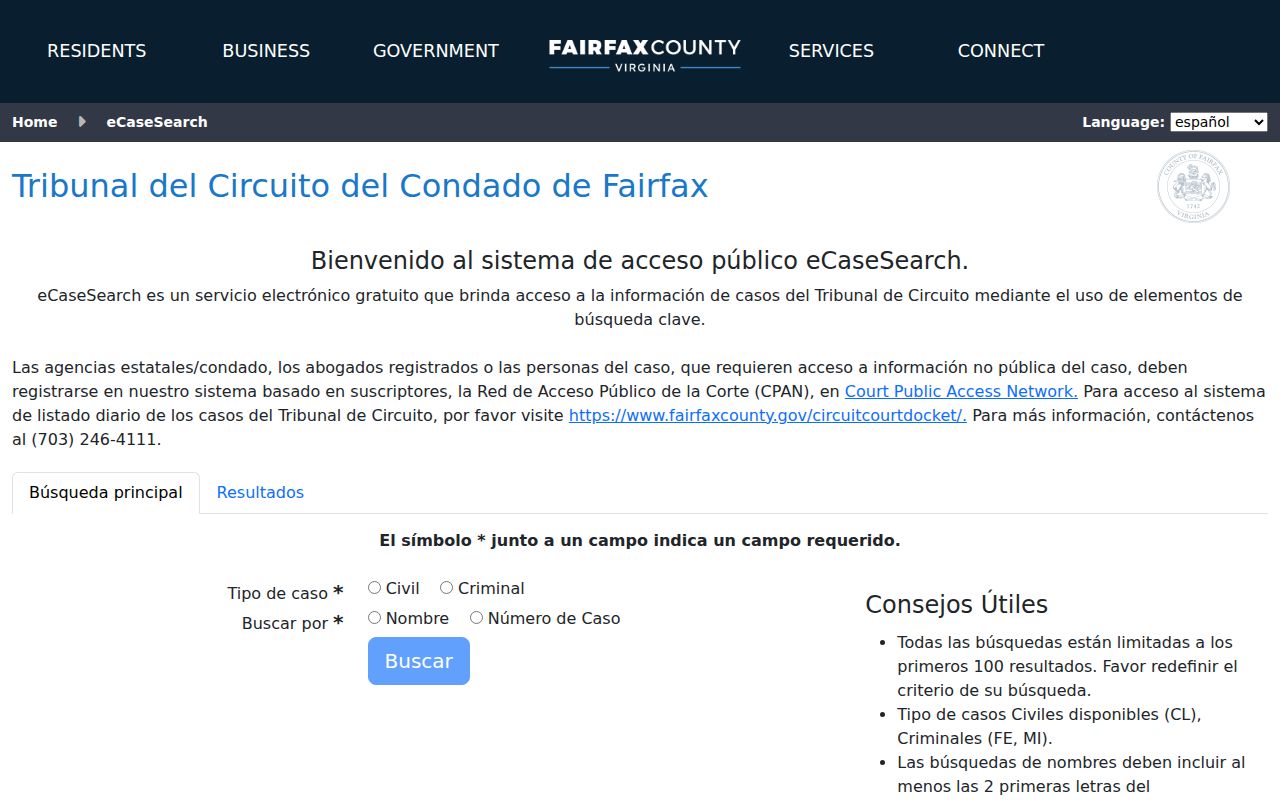
A broad surname will hit the 100-result ceiling fast in a Fair Oaks case-index query. Narrow the search with a first name, the correct case type, or a case number. You can also try the Fairfax locality route. Write down the exact spelling and the search date. That habit lets a later check rest easy. It tells a true no-result from a search that simply got cut off.
| Displayed field | How to use it carefully |
|---|---|
| Case number and type | Separates civil, felony, and misdemeanor index entries and gives the clerk a retrieval reference. |
| Party name | Checks the spelling displayed by the court, not a presumed nickname or household relationship. |
| Hearing, status, and docket actions | Shows the public case timeline, but not a conclusion about current status or residence. |
| Charges or case subtype | Must be read only in the context of the public case record and its limits. |
The 100-result cap is a tool limit, not a census. Plenty more matching cases may exist beyond it. Click any case number for the available details. Deeper or older material goes through the clerk's civil-record channels, the courthouse counter, the Merrifield Offsite Records Center where applicable, CPAN, or the Virginia Room's designated CPAN station. Sealed, juvenile, and adoption files stay outside every one of those routes.
Verify a Fair Oaks Resident Match
A solid Fair Oaks resident lookup tests each fact against its own record. Start with a full name or a known address. Note the source date and the geographic label the custodian actually used. Fairfax County's MAR, iCare, and Jade tools can settle address spelling, unit, ZIP, and subdivision. They also cover parcel context and historic address status. They cannot turn an owner, taxpayer, business, caregiver, or dated listing into an occupant. Common names demand more care. Add a middle name or initial. Try an event year, parcel context, or a documented organization tie. Then merge two hits into one person.
- Start with the known Fair Oaks address or full name. Confirm whether the site is in Fairfax County and save the official spelling, ZIP, parcel context, and relevant date.
- Choose the public index that answers the actual question. A party search can test a court-name variant, while a license or entity search can test a stated public role.
- Compare independent attributes, such as middle initial, event date, organization, address history, or PIN. Do not rely on a surname alone.
- Ask the custodian for the next authorized record only if the index result supports it. Keep a restricted, sealed, or no-result outcome as the outcome.
- Docket
- A docket is the court’s chronological list of public case actions, hearings, and filings. It is not a personal profile.
- Index and image
- An index points to a record or case number. An image is the underlying scan or document, which may require clerk access or may be restricted.
- Certified copy
- A certified copy is a custodian-issued copy with official certification. It is different from an online index entry or an ordinary scan.
Historical evidence carries its own date label. A Fair Oaks directory entry makes a fine lead. The edition and its geographic scope decide how far it reaches. The Fair Oaks city directory collections hold the older directory trail, and a current county or state record must back any present-tense conclusion on its own.
Note: A common-surname hit stays a lead until an independent Fair Oaks record supplies a matching date, address, or organization context.
Fair Oaks Resident Lookup Vital Rules
Virginia keeps vital records locked down tighter than most public files. Certified copies of a Fair Oaks birth, death, marriage, or divorce record come only through the Office of Vital Records. No other office issues them. That single state agency runs every route: online orders, mail, the Richmond walk-in counter, local registrars and health districts, plus limited genealogy and historical-repository access. There is no open name-search database for these files. The fee stands at $15 per certified copy or search, effective July 1, 2026. Processing estimates shift depending on the channel. The office cites about two weeks online. Some paper instructions mention four. Confirm the current timeline before filing. The state application covers birth, death, marriage or divorce, and special-use birth requests.
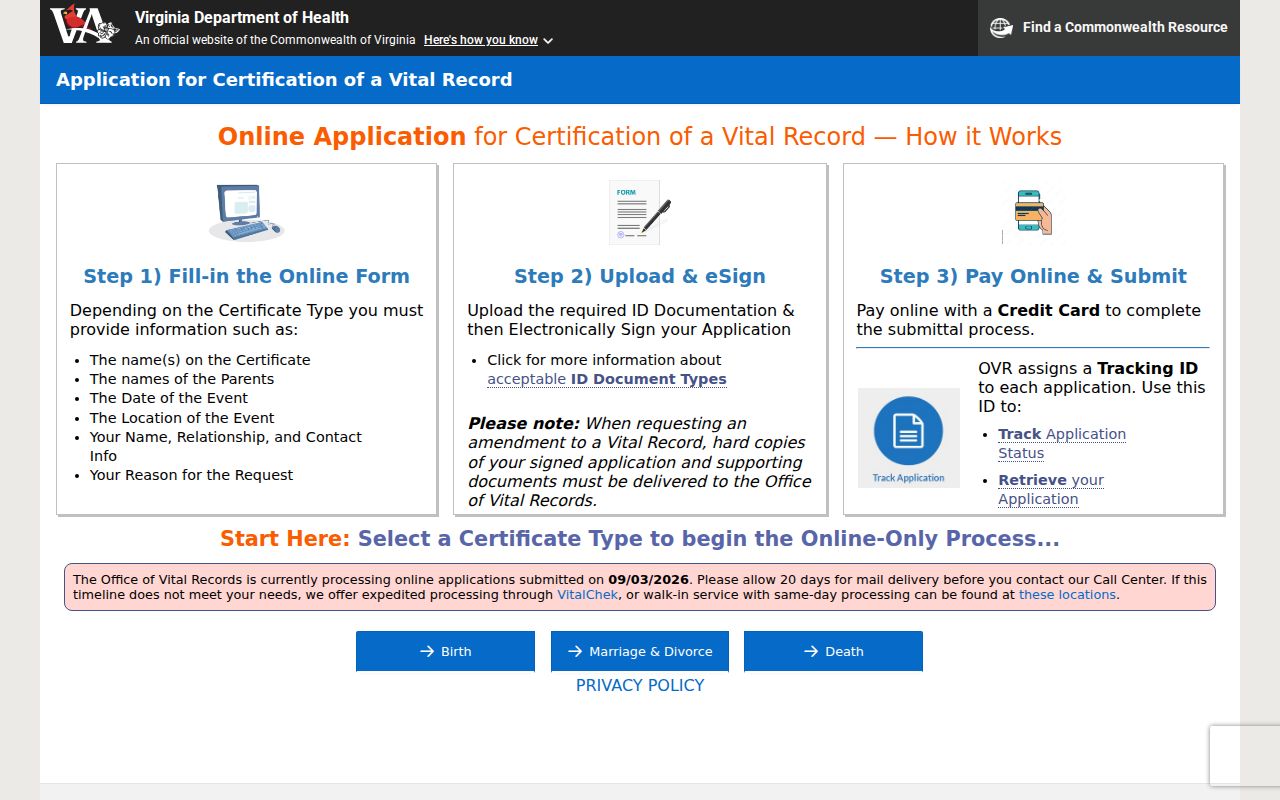
Who may ask, and for what, drives every vital-records request in Fair Oaks. An eligible requester presents the record type, the event name, the event date and locality. Contact details are required as well. A signature and a legible ID copy are needed. Payment and any required custody or authorization proof complete the application. Immediate family usually qualifies. That means a parent, spouse, child, sibling, or grandparent holding valid ID. A guardian must show custody proof instead. Aunts, uncles, cousins, in-laws, and unrelated applicants generally cannot receive a certified copy at all.
Timing matters too. Virginia opens birth records after 100 years. Death, marriage, divorce, and annulment records become public after 25 years. The state index is narrower than a certificate. Images arrive with Social Security numbers redacted. For an older Fair Oaks lead, try other sources. The Fairfax Historic Records Center and the Library of Virginia often fit better than an ineligible current-certificate request.
Note: Confirm any Fair Oaks local registrar counter route with the Fairfax Health District or state office before visiting.
Fair Oaks License and Entity Checks
A narrow public role can separate two people who share a name in a Fair Oaks resident lookup. Virginia's DPOR License Lookup takes a person or business name, license number, address, or license type through its Search Text and Advanced Search inputs. Results can show the license number, the holder's name, issue and expiration dates, classification, status, and address of record. Phone numbers stay out. Treat the address as a regulatory contact field. It is not proof of a Fair Oaks home.
The same DPOR lookup screen displays the Search Text and Advanced Search entry points, a license-type prompt, and a public-data notice for anyone weighing what the results mean.
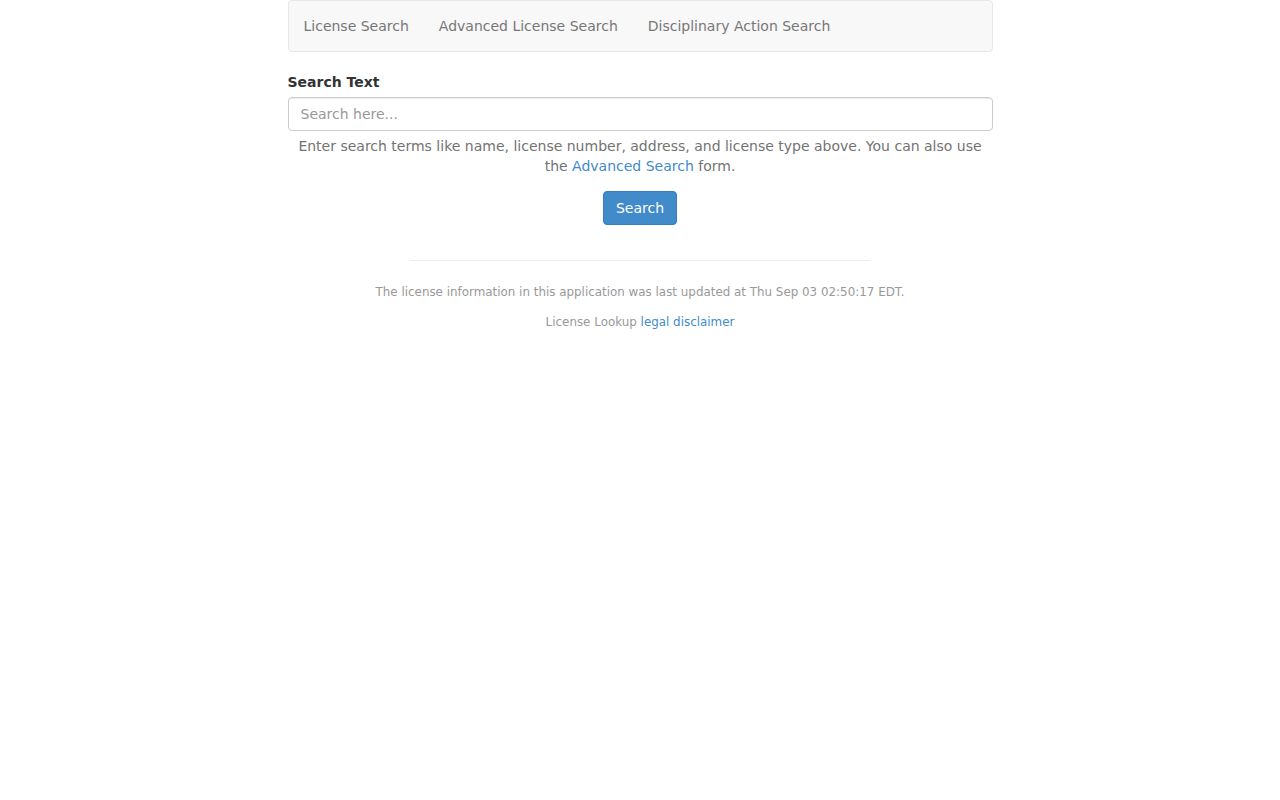
Need more than the online result? DPOR lists a records channel by email and fax. Open discipline orders dating to April 1, 2002 sit online. Open investigations stay private until closed. Keep the board, status, date, and exact license number in your Fair Oaks search notes rather than folding an address of record into a residence claim.
For organizations, the SCC Clerk's Information System is the parallel tool. Search by entity name or ID. Then sort out the public entity, registered agent, registered office, principal office, filing, and status fields. A registered office is just a service address for the entity. It never proves that an individual lives in Fair Oaks.
Fair Oaks Voter Record Boundaries
Virginia keeps a voter's own registration check separate from public voter-list products. A Fair Oaks voter logs into the Virginia Citizen Portal to view personal status. They can also make permitted changes there. The public route runs through the state Voter List Request Form. There the requester declares a category, a product, contact details, data filters, and a locality or district. Election or date details round out the form. It is not an unrestricted Fair Oaks resident lookup by name.
Virginia Code §24.2-444 lists public fields such as name, address, year of birth, and gender. Election districts are public as well. Sensitive components and protected residences stay excluded. Frame a request around the geography the product actually supports. That could be Fairfax County, a precinct, a locality, an election district, or another listed filter. The Fairfax Office of Elections handles counter, phone, email, and formal-request routes for existing public records. Statutory inspection is available there too.
Self-service and a formal list order are two different Fair Oaks records activities. A public-list inspection is a third. Log which one produced a result. Never try to rebuild a protected, military, overseas, or confidentiality-program address from some other field.
Fair Oaks Resident Lookup Privacy Stops
Some Fair Oaks records should stop a search cold. Virginia's Address Confidentiality Program gives eligible participants a designated address, and the real address goes only to authorized program, law-enforcement, or court-order uses. Participant-identifying records are exempt from VFOIA. Courts can seal files. Adoption and juvenile materials carry their own access limits. Vital records stay confidential within their statutory windows, and the Fairfax Adult Detention Center publishes no inmate-account information as a public record.
A missing result deserves the same caution. The gap may reflect a spelling variation, a portal maintenance message, an address outside the Fair Oaks CDP, a coverage-date gap, a restricted file, or a record that was never created. Write down the exact query, the source date, the portal message, and the authorized fallback. Do not fill the gap with an inference.
Fair Oaks Resident Lookup Legal Limits
Put a Fair Oaks resident lookup to a defined, lawful personal purpose. Family history, reconnecting with a relative, checking a public record with its custodian, or documenting an estate question all qualify. Keep only the information that purpose needs. A parcel yields a PIN and owner-of-record context. A court index yields a public case reference. Neither one adds up to a complete identity file. For county administrative records, a reasonably specific Virginia Freedom of Information Act request can seek existing records, though court records travel through the clerk and court channels rather than ordinary county VFOIA processing.
Lawful use. Use limited public fields for a specific, lawful purpose. Do not use a Fair Oaks resident lookup to stalk, harass, pressure, or intimidate anyone, and do not try to bypass a protected record.
Note: A record's source date, coverage date, and event date can differ, so retain all three before relying on any Fair Oaks result.
Dates rarely mean the same thing twice.